


Residual Disability Rider: What It Is, How It Works, and Why It Matters
When clients think about disability insurance, they typically picture a single defining event — a car accident or sudden injury — that leaves them completely unable to work. The reality is far less dramatic, and far more common.
Most long-term disability claims stem from illness, not injury. And most illnesses don’t flip a switch. They gradually erode a client’s ability to work — reducing hours, limiting capacity, cutting income — long before total disability ever enters the picture. Without the right coverage, a client could be losing significant income and collecting nothing.
That’s the gap a residual disability rider — also called a partial disability rider — is designed to close.
What Is a Residual Disability Rider?
A residual disability rider is an add-on to a disability insurance policy that pays a proportional benefit when a policyholder experiences a partial loss of income due to illness or injury — even if they don’t meet the threshold for total disability.
Most policies require a minimum income loss of 15% to 20% before residual benefits are triggered. Once triggered, benefits are paid proportionally: a 30% loss of pre-disability income results in 30% of the total monthly disability benefit. When income loss reaches 75–80%, most carriers treat the insured as totally disabled and pay the full benefit.
Common triggering conditions include:
- Loss of income (15–20% minimum threshold)
- Loss of time (unable to work a defined percentage of prior hours)
- Loss of duties (unable to perform one or more material and substantial job duties)
Why Typical Disability Policies Fall Short
A traditional disability policy operates on an all-or-nothing basis: a client is either totally disabled and collecting benefits or working and collecting nothing. But what about the physician managing a reduced patient load after a cardiac episode? The attorney whose cancer treatment keeps them out of the office two days a week?
These clients aren’t totally disabled — but they’re not fully functional either and their income reflects it. Without a residual disability rider, they may collect zero benefits despite significant income loss.
Residual Disability vs. Own-Occupation Rider: What's the Difference?
These two features are often confused and the distinction matters for proper coverage design.
An own-occupation provision protects a client who can no longer perform their specific job at all. A residual disability rider protects a client who can still work — just not at full capacity. For many professionals, income loss begins well before they meet the threshold for total disability. Both provisions serve a distinct purpose and are not interchangeable.
How Three Carriers Define the Residual Disability Trigger
The triggering definition is where carrier policies diverge most meaningfully — and where the wrong choice can leave a client underprotected. Here’s how Ameritas, MassMutual and Assurity approach residual disability:
Ameritas — DInamic Cornerstone
Ameritas offers three tiers of residual disability coverage: Enhanced Plus, Enhanced, and Basic.
With the Enhanced Residual Disability Rider, benefits are triggered when an illness or injury results in a monthly income loss of 15% or more and the insured is either able to perform one or more — but not all — of the material and substantial duties of their occupation, or is unable to engage in their occupation for more than 80% of their prior schedule. If income loss exceeds 75%, the insured is treated as totally disabled.
The Enhanced Plus version extends recovery benefits for the full benefit period. The Basic rider also requires a 15% income loss but caps the maximum monthly benefit payout more restrictively. Notably, Ameritas uses an income-only loss trigger, which can be advantageous for business owners and fee-for-service professionals whose income doesn’t always move in lock step with hours worked.
Best for: Medical professionals, fee-for-service earners and clients who want tiered coverage options.
Mass Mutual — Radius / Radius Choice
MassMutual offers one residual option: the Extended Partial Disability Benefits Rider (EPR).
It provides a disability benefit when, while actually working in their usual occupation, the insured has lost at least 15% of pre-disability income as a result of sickness or injury. During the first six months of partial disability, the insured may also qualify if — due to sickness or injury — they can perform one or more, but not all, of their substantial and material duties or can perform all duties but for no more than 85% of the time previously performed.
MassMutual’s trigger is notable for accepting a 15% loss of income, time or duties independently — one of the more comprehensive trigger definitions in the market.
Best for: High-income professionals seeking a single, well-defined residual benefit with a low income loss threshold.
Assurity — Century+
Assurity is a solid option for clients in non-medical occupations and their residual disability rider is available as an optional add-on to their Century+ policy. Assurity’s rider generally follows the industry-standard income-plus-duties/time model. For precise trigger language and current benefit caps, reviewing the policy form directly or speaking with your dibrokerWest Sales Rep is recommended before client presentation.
Best for: Non-medical occupation classes seeking affordable, customizable disability income coverage.
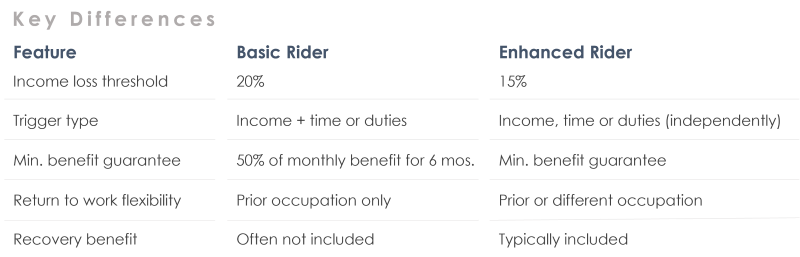
Basic vs. Enhanced Residual Disability Riders: Key Differences
Most carriers offer two tiers of residual coverage. Here’s what separates them:
Frequently Asked Questions About Residual Disability Riders
What is the difference between a residual disability rider and a partial disability rider?
The terms are often used interchangeably, though some carriers distinguish between them. A partial disability benefit may be built into a base policy and typically lasts a limited time. A residual disability rider is usually an optional add-on that pays proportional benefits for the full benefit period.
Do all disability insurance policies include a residual disability rider?
No. Some policies include residual benefits as a standard feature; most offer it as an optional rider at an additional premium. Certain carriers — like Ameritas for medical occupation classes — require it.
How are residual disability benefits calculated?
Benefits are generally proportional to income loss. If a client loses 40% of their pre-disability income, they receive 40% of their total monthly disability benefit. When income loss reaches 75–80%, most insurers pay the full benefit.
Is a residual disability rider worth the additional premium?
For most professionals — especially those in fee-for-service or specialized occupations — yes. The majority of long-term disability claims are illness-related and begin as partial disabilities. Without a residual rider, a client could experience substantial income loss without receiving any benefits.
The Conversation Worth Having
Disability rarely arrives as a clear-cut, total event. For high-income professionals whose earning power is their most valuable asset, partial protection isn’t enough. A residual disability rider ensures that a gradual illness or partial recovery doesn’t become a financial crisis.
If a client’s current policy doesn’t include one, it’s worth a second look.
Did you know?
Policy language, benefit tiers and trigger definitions are subject to change. Always verify current terms with your dibrokerWest Sales Rep or directly with the carrier before presenting to clients.

