


AUM vs. Disability Insurance: Which Pays More for dibrokerWest Advisors?
As a financial advisor, how you structure your compensation model has a direct impact on your income trajectory, your workload and the sustainability of your practice. Two common revenue streams — managing assets under management (AUM) and selling disability insurance — operate on fundamentally different financial models. Understanding the difference isn’t just academic; it’s a strategic decision that shapes your business for years to come.
The Case for AUM: Slow Burn, Big Reward
Managing client assets is the backbone of many advisory practices. AUM fees are recurring, predictable and grow as your clients’ portfolios grow. A typical advisory fee of 0.75–1.25% on a $1M client relationship generates $7,500–$12,500 per year — and that income compounds over time as markets appreciate and clients add assets.
The real power of AUM is what happens after Year 3. Once a client relationship is established, the income essentially perpetuates itself with minimal additional effort. You’re being paid for stewardship, not for new activity. A practice managing $50M in AUM at 1% generates $500,000 annually — regardless of how many new clients you bring on that year.
The tradeoff? Building an AUM practice takes time. In the early years, income can feel modest relative to the effort of acquiring clients, onboarding assets, and demonstrating value.
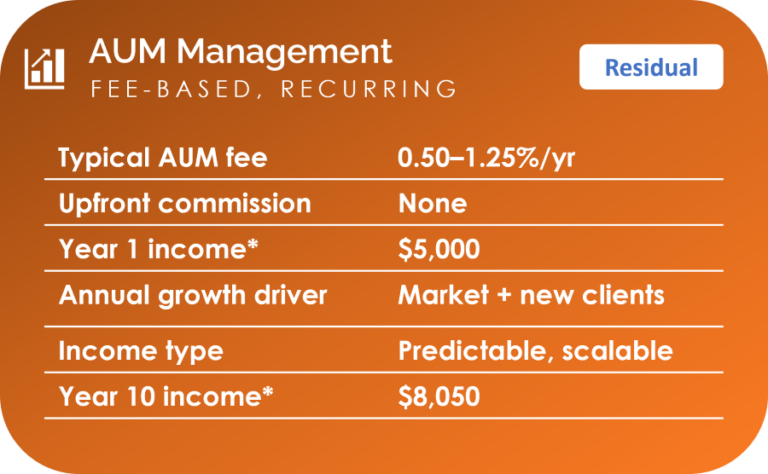
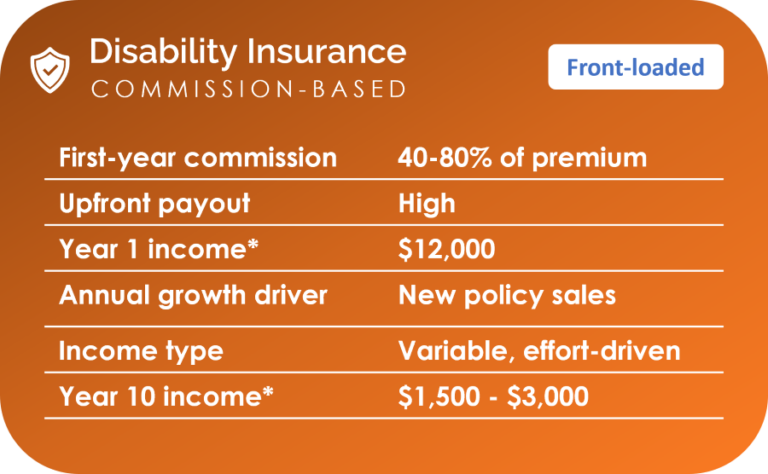
*Illustrative figures. AUM: $1M client, 1% fee, 5% annual growth. DI: $20K annual premium, 60% FYC, 5% renewal rate. Actual results vary by carrier, state and product.
The Case for DI: Front-Loaded Cash Flow
Disability insurance is a very different value proposition. When you place a disability policy, the commission structure rewards you immediately and heavily. First-year commissions (FYC) typically range from 40% to 80% of the annual premium. On a $20,000 annual premium policy, that’s $8,000–$16,000 in Year 1 alone.
For newer advisors or those building their practice from scratch, this front-loaded income model can be a significant advantage. It generates cash flow quickly, without waiting for an AUM book to accumulate. It also provides an opportunity to layer DI sales on top of existing client relationships — and at dibrokerwest, those conversations can often surface naturally when working with business owners, high-income earners or clients going through major life transitions.
The catch is sustainability. After Year 1, renewal commissions on disability policies typically drop to 5–10% of the premium — meaningful but a fraction of what the initial sale generated. To maintain income from DI alone, you have to keep selling. It’s activity-driven income, which means your revenue is only as strong as your pipeline.
The Smarter Play: Use Both
The advisors who build the most durable practices don’t choose between AUM and disability insurance — they use them together. DI sales generate the upfront income that funds practice growth in the early years, while AUM accumulates quietly in the background and builds into a compounding revenue base over time.
Think of it this way:
A client you place a disability policy for in Year 1 is a client you can deepen into an investment relationship by Year 2 or 3. The DI conversation opens the door; the AUM relationship keeps them for decades.
What This Means for Your Practice
If you’re newer to the business, lean into disability insurance to build cash flow while you develop your AUM base. If you’re more established, DI sales are an excellent way to add revenue per client without taking on the operational complexity of new asset relationships.
Either way, knowing how each model pays puts you in a stronger position to build a practice that works for you, not just in the years ahead but right now.
Do you have questions or need more information? Reach out to your Local Sales Rep.


